
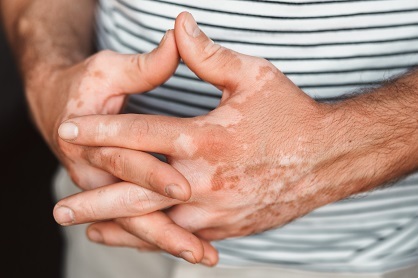
Vitiligo is a chronic, non-contagious skin disorder characterized by the appearance of depigmented (white) patches on various parts of the body, caused by the loss or dysfunction of melanocytes (the cells responsible for skin pigment). It affects approximately 1–2% of the global population, with onset most commonly occurring between the ages of 10 and 30.

Key Symptoms and Manifestations
The condition typically develops gradually but can progress rapidly in some individuals. Main symptoms include:
- Depigmented Patches: Smooth, white, or pale spots with well-defined borders.
- Premature Graying: Hair growing within the affected areas (on the scalp, eyebrows, eyelashes, or beard) may turn white or gray prematurely.
- Mucosal Involvement: Loss of color can occasionally affect the tissues inside the mouth, nose, and genital areas.
- Sun Sensitivity: Depigmented zones do not tan and are highly susceptible to sunburn.
Note: Vitiligo patches are generally asymptomatic; they do not itch, hurt, scale, or cause physical discomfort.
Forms and Classification of Vitiligo
Depending on the location and spread of the patches, vitiligo is classified into several distinct clinical forms:
| Form | Characteristics |
|---|---|
| Non-segmental (Generalized) | The most common form. Patches appear symmetrically on both sides of the body (e.g., both hands or both knees). |
| Segmental | Patches are restricted to one side of the body or a specific segment/dermatome. Often develops at a younger age. |
| Focal | Depigmentation is isolated to a few small areas without widespread distribution. |
| Universal | Widespread depigmentation covering up to 80% or more of the entire body surface. |
Causes and Triggers
The exact cause of vitiligo is multifactorial, meaning it arises from a combination of genetic and environmental influences. Key theories and triggers include:
- Autoimmune Response: The body’s immune system mistakenly attacks and destroys its own melanocytes.
- Genetic Predisposition: A family history of vitiligo or other autoimmune conditions increases risk.
- Neurogenic Factors: Neurochemicals released at nerve endings in the skin may damage melanocytes.
- Oxidative Stress & External Triggers: Severe sunburns, critical psychological stress, exposure to industrial chemicals, or physical skin trauma (Koebner phenomenon).
- Endocrine Disorders: Frequently associated with thyroid dysfunction or diabetes.
Diagnostic Procedures
Comprehensive diagnostics are essential to differentiate vitiligo from other depigmenting skin conditions. Standard evaluations include:
- Clinical Examination & Dermoscopy: Detailed visual assessment of the skin structure using a dermatoscope.
- Wood’s Lamp Examination: Utilizing ultraviolet light to identify areas of depigmentation that may not be clearly visible to the naked eye.
- Laboratory Tests: Blood screening to evaluate thyroid hormone levels and rule out concurrent autoimmune disorders.
- Skin Biopsy: Performed in rare, atypical cases to confirm the complete absence of active melanocytes.
Modern Treatment Options
While there is no definitive cure for vitiligo, modern therapeutic strategies aim to halt the progression of the disease and restore pigmentation to the affected skin areas:
1. Topical and Systemic Medications
- Topical Corticosteroids: Anti-inflammatory creams applied to early or localized patches to stimulate repigmentation.
- Topical Calcineurin Inhibitors (Immunomodulators): Effective alternative treatments, particularly for sensitive areas like the face and neck.
- Systemic Therapy: Oral medications used under strict medical supervision to stabilize rapidly progressing forms of the disease.
2. Phototherapy and Laser Treatments
- Narrowband UVB (NB-UVB): One of the most effective and widely used light treatments to stimulate pigment recovery.
- PUVA Therapy: A combination of a photosensitizing medication (psoralen) and UVA light exposure.
- Excimer Laser: Targeted laser therapy ideal for small, isolated vitiligo patches.
3. Surgical Interventions
For patients with stable vitiligo that has not changed for at least 6–12 months, surgical options such as autologous skin grafting or melanocyte-keratinocyte transplant (cellular transplantation) may be considered to restore skin color.
Important Notice: Treatment choices must always be individualized based on the disease stage, the patient’s age, and the extent of skin involvement. Please consult with a certified dermatologist before starting any therapy.
